

As the latest actual-play series season builds steam, preparing for the final episode of its introductory phase and splitting the cast members into three distinct parties, audiences are still discovering more about the mysterious world of Aramán, crafted by Dungeon Master Brennan Lee Mulligan. Exandria, the universe of past seasons, relied heavily on established D&D lore. However, one of the most thrilling aspects of this new season is how Mulligan plays with those familiar references to create something truly original.
A Fresh Perspective on Celestials and Demons
Viewers have already been introduced to Aramán’s sad and twisted interpretation of the Celestials, but the third installment, called “The Snipping of Shears,” also provides some background about their fiendish counterpart, the demons. This term has been used quite generically in the current season, but what’s most interesting is that it also refers to individuals that would be categorized as “tieflings” in traditional Dungeons & Dragons worlds, including the fiendish spellcaster Tyranny, portrayed by Whitney Moore.
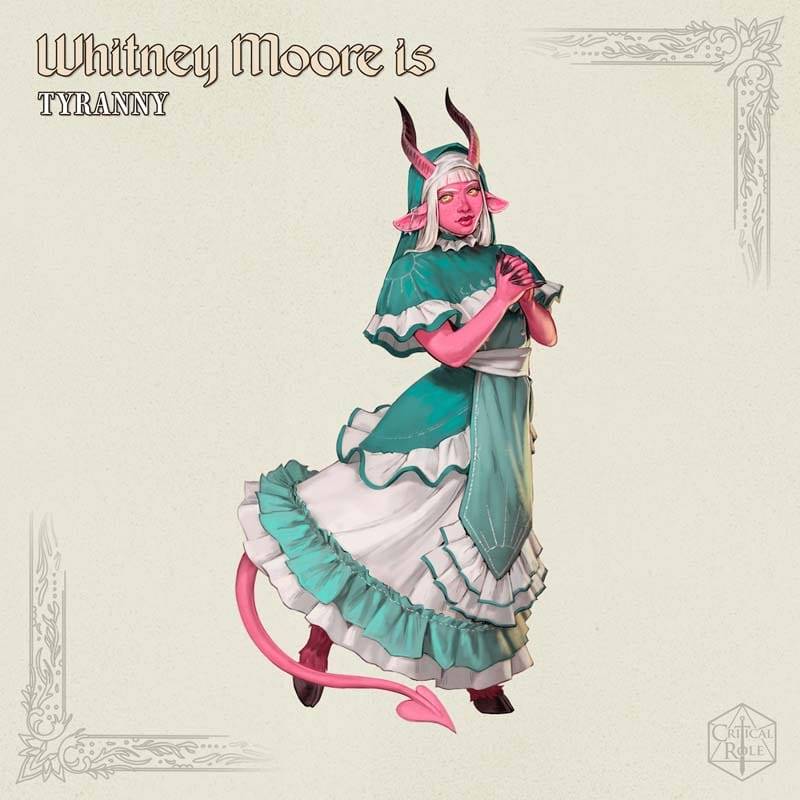
Historically, tieflings are mortals with Fiend ancestry, but it appears that in Aramán, they’re actual fiends whose essences have taken up residence in a physical form as the result of a deal. In the latest episode, it was revealed that these entities reside in a place called the Pit, governed by an sinister entity called High Prince Ksha'aravi. Ksha'aravi struck a deal with a noble family, in which he would supply them infernal agents to use as servants and as examples of salvation for the a religious order. As payment, he would receive human spirits and some of the Filament, a material with divine properties produced by the Halovars.
Deciphering the Fresh Mythology
If you are confused by this, many share your confusion. The Dungeon Master is a master of teasing, and he’s being very careful about how much he discloses in each episode. Still, we can assume from what we know that Aramán’s fiend-blooded characters are infernal spirits who inhabit a mortal body. This is an interesting twist on one popular D&D character species, and one with the potential to make it more engaging.
The Origins of The Fiend-Touched
The origin of tieflings dates back to 1994 and the iconic Planescape Campaign Setting for advanced Dungeons & Dragons. They were vaguely described as mortals with extraplanar ancestry, implying it came from devils, demons, or other malevolent entities. Planescape author Zeb Cook explained afterwards that he left the tieflings' origins vague on purposefully because he simply wanted to create an archetype for a redeemed fiend/antihero character, in part to appeal to the dark and emotional subcultures. Later versions of D&D, though, clarified and restricted those origins (a decision that Cook disapproved of), leading to the widely accepted view that these beings all have ancestry that traces back to the infernal dimensions.

Although the details about that heritage differ a lot, the shared trait is that tieflings are mortals with the blood of Fiends running through their veins. In D&D, Fiends are the inhabitants of the evil dimensions of malevolent nature, including the the chaotic void, the the infernal realm, the prison plane, Gehenna, Pandemonium, and probably a few more that I’m forgetting. This universe structure is common to almost all D&D settings, including the world of Exandria, which has had its ample number of demonic encounters. While these evil creatures are native to the infernal realms, they can be called forth to the Material Plane or access it through gateways. They arrive with their physical bodies, but they can only be truly slain on their native planes.
Breaking with Convention
The portrayal of the infernal domain and its denizens presented in the third episode of this season steers away from these standard features. The High Prince strongly resembles the archdevil, the sovereign of the Nine Hells, with all that plotting and soul bargaining, but my impression is that the fiends in this world do not have a solid form, or at least one they can use to enter the “mortal realm” (or however it’s called in the setting). Tyranny explicitly states in that episode that she was “provided with a form” just half a year prior, and previously she was just a “drifting spirit” in the Pit, so this appears to be the origins of the fiend-touched in this new setting (future episodes may show classic versions actually exist, but given that this character is a player character, this is improbable).
The Original Vision
Going back to Zeb Cook’s interview, he stated that he designed the race to play a specific role: the afflicted, quasi-damned hero/heroine, that wasn’t represented in the game’s high fantasy character lineup at the time. Planescape co-author the other designer said in the same interview that "Tieflings resonate because they're dark and edgy. They've got an inherent mystery. They're misfits and isolates, and they have a valid cause to shun society (and be shunned by it).” With time, however, the darkness that was integral to the background of tieflings got diluted, and they simply became a very popular character option with some extra spells and a cool, different look.
Embracing the Darkness
This is perfectly fine. You can portray a cheerful fiend-blooded character who doesn’t think for a second about their infernal heritage, if that suits your style. However, I think that Brennan Lee Mulligan’s version excels exactly because it doubles down on that “dark” origin, turning it into a core aspect of the persona. By all intents and purposes, Tyranny and her sisters have a form only because of the High Prince’s pacts with the Halovars. When she has the expected liberation storyline, breaking free from the shackles of her infernal kin, it will feel powerful and dramatic because her character species’ origin is woven into the world’s mythology.
Looking Ahead
In addition to this fresh perspective at tieflings, many are eager to discover additional details the infernal realm and this world’s fiends. Fans are enthusiasts for D&D’s cosmology, particularly the lore of the Lower Planes. I could read about conflicts in the infernal kingdom, chaotic battles between Demon Lords, and the mysterious origins of the yugoloth endlessly. Yet, this background is fairly uniform in every D&D setting, so there is anticipation for some fresh, significant expansion to it.


